Email marketing remains the highest-ROI channel in any industry, typically returning around $36 for every $1 spent. For travel agencies and tour operators, it’s the most underused tool in the box – and the most powerful when used well.
Travel email marketing is the practice of using targeted, automated email campaigns to inspire, sell to and retain travellers across the full booking journey: welcome series, trip teasers, pre-departure prep, post-trip thank-yous and rebook nudges. Done well, it builds anticipation, drives bookings and turns one-off clients into long-term repeat customers.
The brands winning at travel email marketing in 2026 aren’t sending more emails – they’re sending smarter ones, using AI and automation to personalise at scale and put the right message in front of the right traveller at exactly the right moment.
Why is email marketing for travel agencies so important?
Email marketing is important for travel agencies because it’s the one channel your brand fully owns. Social algorithms change overnight, paid ad costs creep up every quarter, but your email list keeps producing year after year with no platform sitting between you and your client.
For travel businesses, this matters even more because trips are considered, high-value, emotionally driven purchases that often take weeks or months to convert. Email is the channel that nurtures that journey – from first enquiry to booking to rebooking five years later.
What types of emails should travel companies send?
Travel companies should run a mix of inspirational, transactional and retention email campaigns across the client journey, with most of them automated rather than sent manually. The strongest travel email marketing programmes have these five running at any time:
- Welcome series – introduce your brand, sample your best trips, set expectations.
- Inspiration drops – destination spotlights, seasonal offers, themed itineraries.
- Pre-departure prep – countdowns, packing tips, useful info, automated by trip date.
- Post-trip thank-yous – review requests, photo galleries, triggered after return.
- Rebook nudges – anniversary offers, lookalike trips, triggered by past behaviour.
Generic mass-sends to your full list don’t cut it any more. Segment by trip type, past behaviour and booking stage, then automate everything you can.
c
How often should travel agencies send marketing emails?
Travel agencies should send marketing emails roughly once a week to engaged prospects and twice a month to general subscribers – frequent enough to stay visible, not so much that you train people to ignore you. Relevance matters more than volume.
A weekly inspiration email to people who actually want it will outperform daily blasts to your full list every time. Watch unsubscribes, complaints and click-through rates – if any creep up, you’re sending too much or too broadly.
How can travel agencies use AI and automation for email marketing?
Travel agencies can use AI and automation to personalise emails at scale – combining behavioural triggers, smart segmentation and AI-generated copy to send the right message to the right traveller at the right time, without writing each one manually.
Practical applications:
- Behavioural triggers – fire emails automatically when someone browses a destination, abandons a booking enquiry or revisits a past trip page.
- AI subject lines – tools like Phrasee or ChatGPT generate dozens of variants in seconds, then platforms test them at scale.
- Dynamic content blocks – show different destinations, prices or testimonials based on each subscriber’s past trips or interests.
- AI segmentation – Klaviyo, ActiveCampaign and similar platforms auto-group subscribers by behaviour patterns no human team would spot.
- Send time optimisation – most modern email platforms use AI to deliver each subscriber at their personal most-likely-to-open window.
- AI copy drafting – ChatGPT, Claude or Gemini for first drafts; your team edits for brand voice and adds the human touch.
The travel agencies winning here treat AI as a junior team member, not the editor. AI drafts, suggests and automates – your team approves, tunes and sends. Learn more about the latest AI tools travel companies are using to save hours each week.
What makes a great travel marketing email?
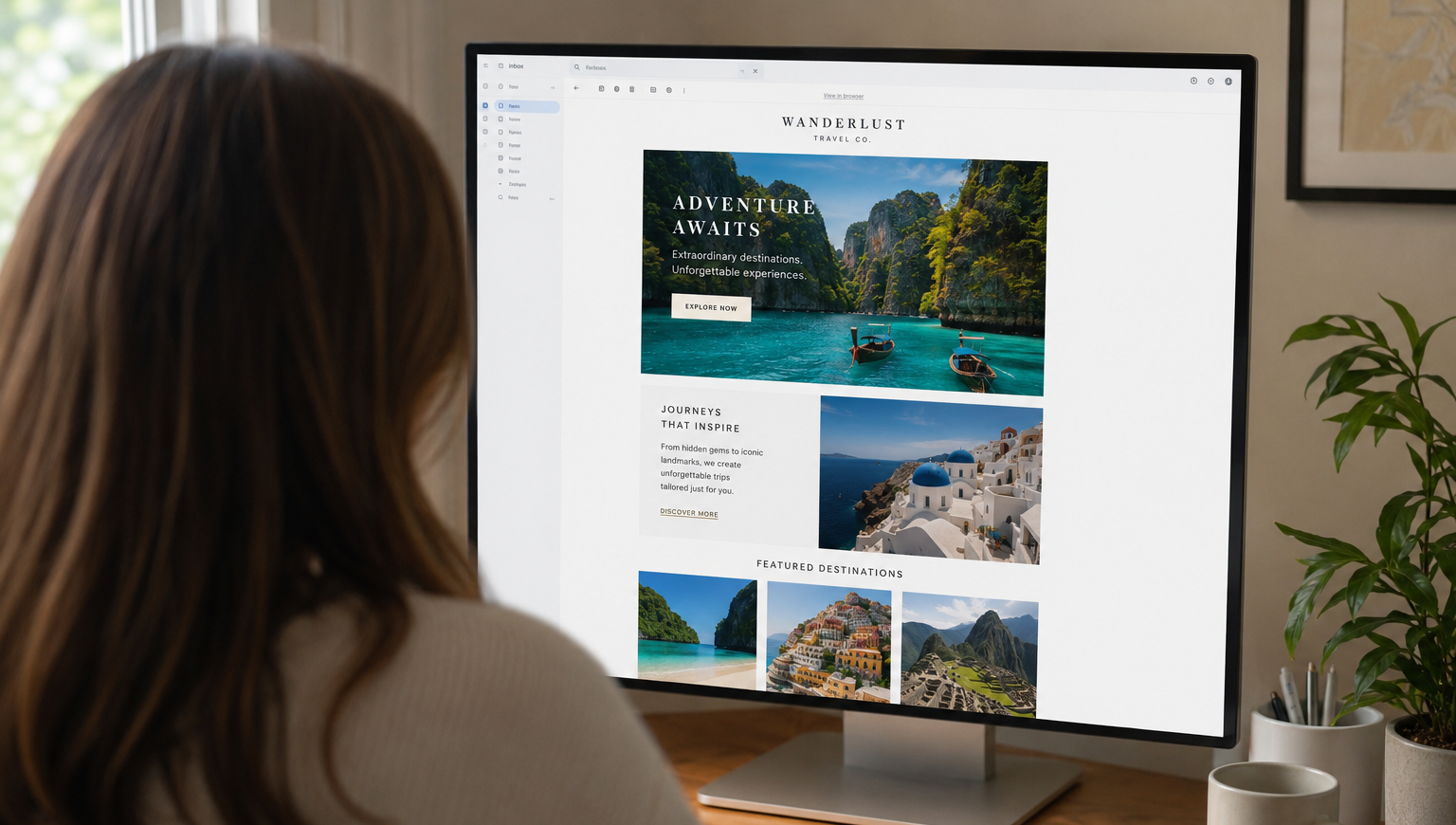
A great travel marketing email is short, visually striking, personally relevant and built around a single clear call to action. It feels like a friend sending a tip, not a brand sending a brochure.
Best-practice principles:
- Subject line first – specific, curiosity-led, ideally under 50 characters.
- Use a named sender – “Sarah at Black Tomato” outperforms “noreply@” every time.
- A select few images, not ten – travel sells on imagery, so pick the best photos and let them lead.
- One call to action – “explore Patagonia” beats six competing buttons.
- Write for mobile – the majority of emails open on phones; keep paragraphs tight.
- Send Tuesday or Wednesday mornings – consistently the best-performing slots.
- Authenticate your domain with SPF, DKIM and DMARC – non-negotiable now that Gmail rejects unauthenticated bulk mail outright.
Test relentlessly. The brands with the highest performance aren’t the ones with the best designers – they’re the ones with the best testing habits.
How to make your marketing messaging actually land
Even when you do everything right with email, there’s a hard ceiling: with travel email open rates averaging just 15.70%, the majority of your messages never get opened. AI-powered spam filters are getting more aggressive, promotions tabs are getting more crowded, and Gmail is now rejecting non-compliant bulk mail at the server level. Your best campaign can still get lost in the noise.
That’s why the smartest travel agencies in 2026 pair travel email marketing with a second channel: a branded app like Vamoos that delivers content directly to their client’s phone via push notifications, no inbox required.
Vamoos gives travel companies a marketing channel that lives on their client’s home screen – useful before, during and after the trip:
- Pre-trip content – destination guides, packing lists, visa info, weather updates and countdown reminders delivered straight to the app rather than fighting for inbox space.
- In-trip support – itineraries, maps, documents and real-time updates available offline, wherever your traveller is in the world.
- Post-trip rebooking – monthly push notifications nudging past passengers to explore your other trips, with one-tap contact to your sales team.
Travel app push notifications see a click-through rate of 5.29% on Android and 3.97% on iOS – several times higher than the typical travel email click rate. Pair that with the Vamoos in-app e-brochure and you’ve got a second front for every campaign: if the email gets buried, the notification gets through.
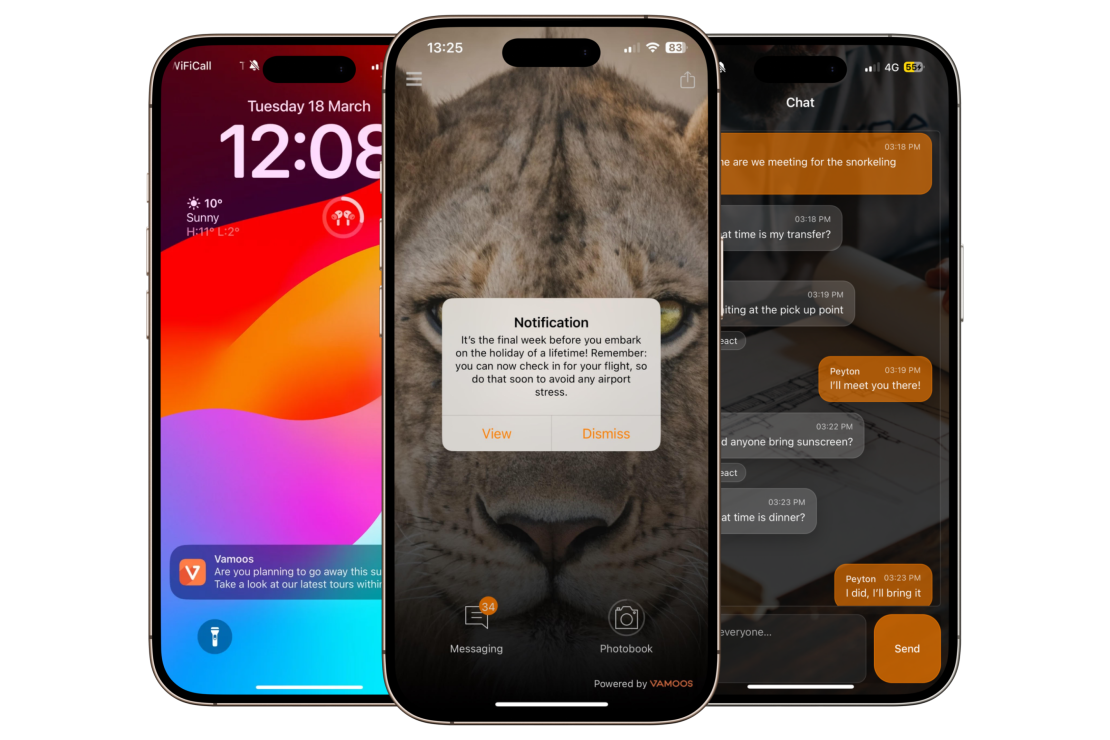
Vamoos clients see a 12% increase in repeat bookings after launching, with 500+ travel companies across 50+ countries – including Black Tomato, Scott Dunn and Savile Row – using the app as a marketing channel that complements (not replaces) their email programme.
Ready to add a second marketing channel that delivers straight to your clients’ phones? Book a call with the Vamoos team and we’ll show you how Vamoos works alongside your travel email marketing strategy.
Read more:
FAQs
What is a good open rate for travel email marketing?
A good open rate for travel email marketing sits above the industry average of 15.70%, though this varies depending on list quality and segmentation. Agencies sending relevant, well-segmented campaigns to engaged subscribers typically see higher rates than the average, while broad, unsegmented sends to a full list usually pull it down.
How do I grow my travel agency’s email list?
The most effective way to grow a travel agency’s email list is to capture enquiries at every touchpoint, from website visits to post-trip conversations, rather than relying on a single sign-up form. Offering something genuinely useful in exchange, like a destination guide or packing checklist, converts more browsers into subscribers than a generic “join our newsletter” prompt.
What’s the difference between email marketing and app push notifications for travel companies?
Email marketing relies on a traveller opening their inbox, while app push notifications deliver directly to a client’s home screen without competing for space in a crowded inbox. Travel app push notifications see click-through rates of 5.29% on Android and 3.97% on iOS, several times higher than typical travel email click rates, making the two channels complementary rather than interchangeable.
Can small travel agencies do email marketing without a big team?
Yes, small travel agencies can run effective email marketing without a dedicated marketing team, using automation to handle the workload a larger team would otherwise manage manually. Platforms with built-in automation can trigger welcome series, pre-departure reminders and rebook nudges automatically, so a single person can run a full programme rather than writing every email by hand.
What’s the best email marketing platform for travel companies?
There’s no single best email marketing platform for travel agencies, since the right choice depends on list size, budget and how much automation you need. Klaviyo and ActiveCampaign are strong choices for agencies wanting advanced behavioural triggers and AI segmentation, while simpler platforms suit smaller operators just starting to automate their welcome series and pre-departure emails.