The way travellers search has changed. They’re no longer just typing keywords into Google – they’re asking ChatGPT, Claude and Gemini full questions, and booking based on the answers. A strong GEO strategy for travel companies has become the difference between being found and being invisible.
It matters more than most operators realise. In our recent webinar, Lalit Gupta from Google shared that questions are becoming quests, with AI Mode queries now 2 to 3 times longer than traditional search. Yet barely anyone is acting on it. In a recent Vamoos study, we found that only 10% of travel companies have an active GEO strategy in place, meaning 90% of the industry is wide open territory – which makes right now the moment to move.
To get found by AI search, travel companies need to do three key things:
- Make sure your website is easy for AI to read
- Earn third-party mentions and reviews across the web
- Structure content to answer the questions travellers actually ask
The rest of this guide breaks this down in an actionable way.
What is SEO and GEO?
SEO and GEO are the two practices that get your travel company found in modern search. SEO (search engine optimisation) is the practice of getting your website to rank on Google’s results page. GEO (generative engine optimisation) is the practice of getting your business cited and recommended by AI tools like ChatGPT, Gemini, Claude and Google AI Overviews.
The two overlap heavily – to get found by AI search, SEO is roughly 90% of the work and GEO is the extra 10% on top – because AI engines crawl the web much the same way Google does. If your SEO foundations aren’t solid yet, start with our guide to travel SEO and come back here for the AI layer. The travel companies who get both right will dominate the next decade of inbound enquiries.
This guide draws on insights from our recent webinar with Google, plus poll data from the travel companies who attended. We’ll cover what’s changing, why it matters, and exactly what you can do this week to start showing up.
What’s changing in travel search?
Search queries are getting longer, smarter and more conversational. Google reports that searches longer than eight words now make up the bulk of query volume – and they’re growing fast. A traveller no longer types “Kenya safari” – they ask “what’s the best small-group safari operator for a family with kids under 10 visiting in July, with a budget of £15k”. That’s a quest, not a query.
The shift has real consequences for inbound traffic. Our study found that Google (organic and paid combined) drives 52% of inbound traffic for travel companies. If Google’s surfaces shift towards AI answers, that’s half the funnel exposed to change.
Lalit Gupta from Google joined our recent webinar to walk travel companies through exactly how search is changing. You can watch his full session here.
The good news? AI search creates a much wider, more diverse web. Smaller tour operators who go deep on niche expertise can now be found by travellers they’d never have reached on a generic Google search.
So what can you actually do to get found by AI travel search?
Our Senior Marketing Manager Harriet O’Connor walked us through the GEO action plan she’s been using on the Vamoos site. travel companies through the GEO action plan she’s been using on the Vamoos site. It’s the practical version of everything that follows – watch it first, then use the rest of this guide as your reference to work through at your own pace.
How does travel SEO differ from GEO for travel companies?
SEO differs from GEO for travel mainly in what you optimise for: SEO targets the short keywords people type, while GEO targets the full, conversational questions people ask AI. A traditional SEO page might be built around “Kenya safari cost”; the GEO version of that same page is built around “how much should I budget for a 10-day Kenya safari for two?” In practice, that slightly changes how you write. SEO content weaves keywords into headings, metadata and body copy. GEO content leads with a question as the heading and answers it in the very first sentence, so an AI can lift that answer cleanly. You’re writing for extraction, not just ranking – which is why FAQs, specific figures and plain-English phrasing matter more for GEO than they ever did for SEO.
The other big shift is where authority comes from. SEO has always rewarded backlinks (other sites linking to yours). GEO leans more heavily on what people are saying about you across the web – public reviews, Reddit threads, press mentions, forum chatter. AI models are trained on all of it, so a glowing Reddit thread about your safari operator can shape what ChatGPT recommends, even without a single backlink.
What type of AI queries should travel companies be targeting?
Travel search is splitting into two distinct AI moments, and operators need to win both.
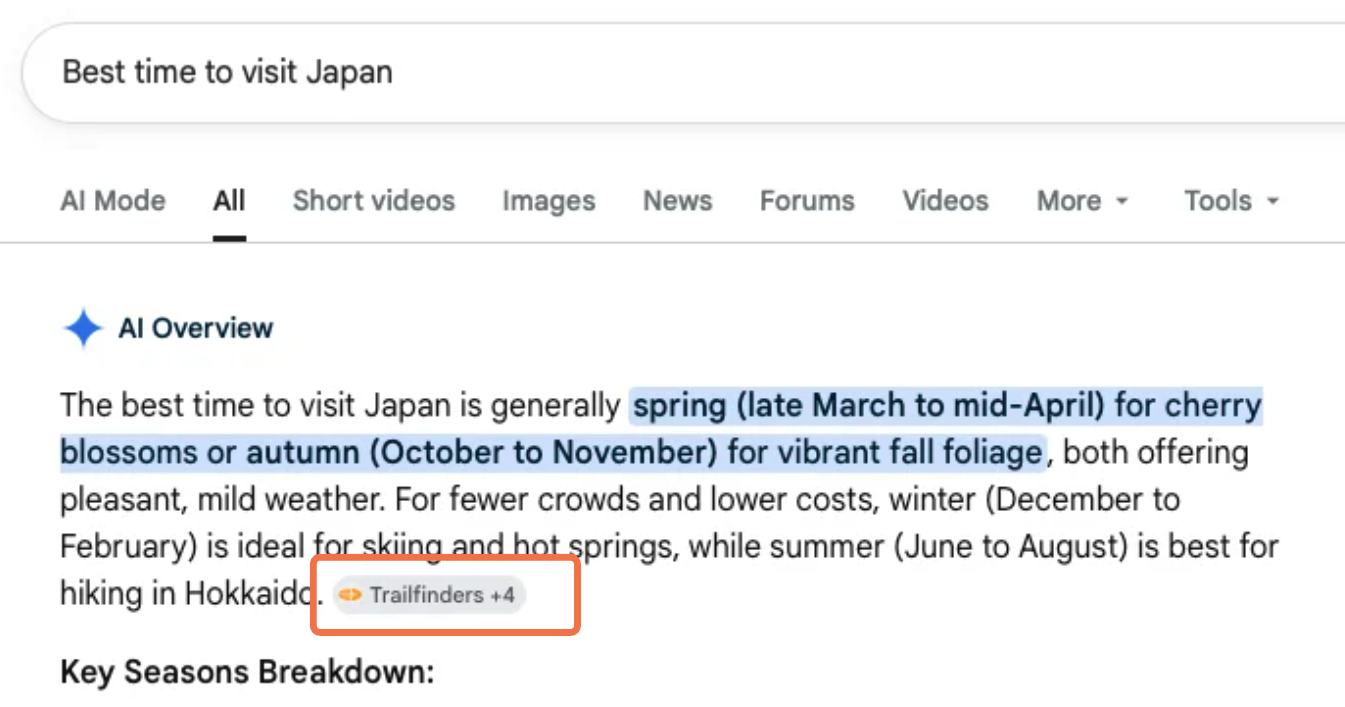
The first is citation – someone planning a trip asks “best time to visit Japan” or “7-day Kenya safari itinerary”, and you want AI to quote your content as the source.
The second is recommendation – someone choosing who to book with asks “best small-group operators for Patagonia”, and you want AI to name you.
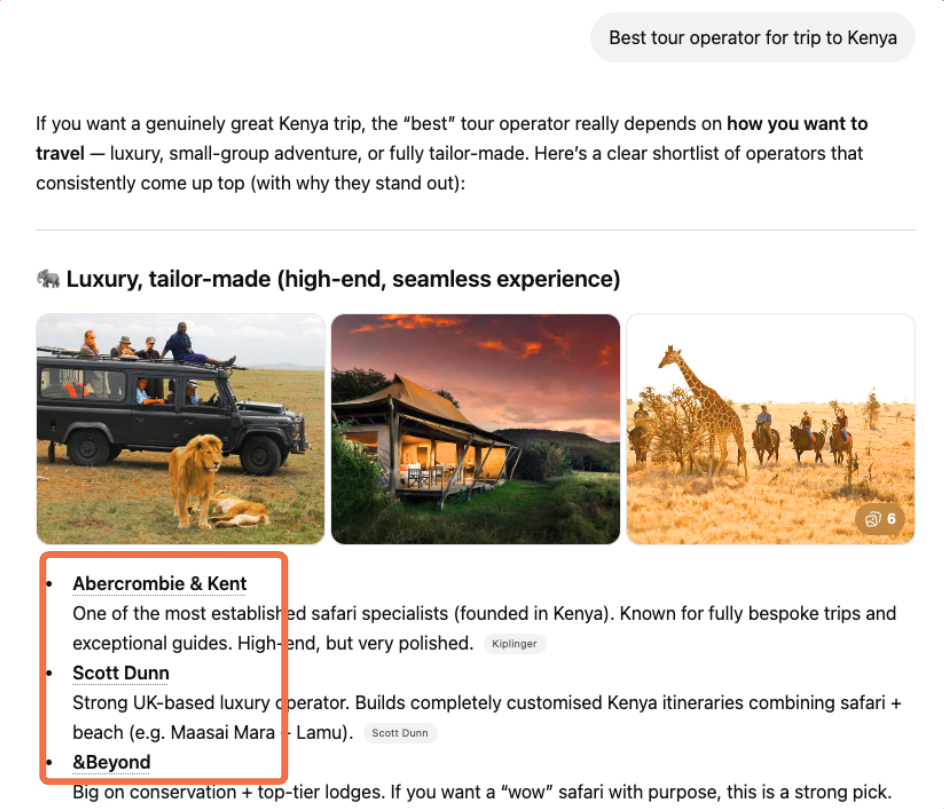
Citations come from owned content on your own site. Recommendations come from earned content others write about you online. Both need attention.
The 4 pillars of GEO for travel
Strong AI visibility rests on four pillars. Most operators can tackle pillars 2, 3 and 4 in-house. Pillar 1 usually needs a developer or a technical audit tool – Claude and other LLMs can now run these for you.
- Technical site foundation – is your site crawlable, fast and structured for AI to read? Find out more here.
- On-site optimisation – the content you own. Question-led headings, FAQs, extractable answers.
- Off-site authority – what others say about you online. Reviews, PR mentions, listicles, YouTube videos.
- Monitor and iterate – track rankings and AI mentions over time with tools like SEMrush, Ahrefs or Google Search Console.
How can travel companies get cited by ChatGPT?
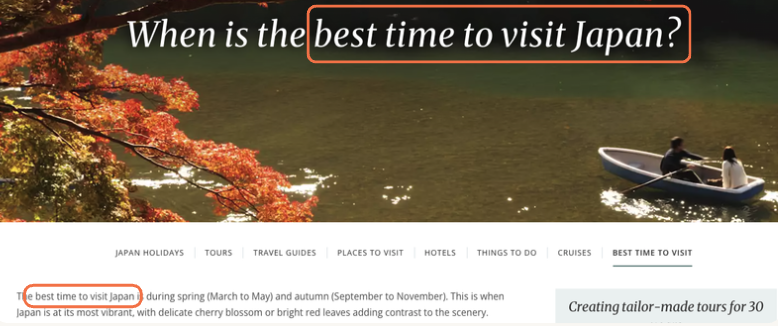
You get cited by writing original, in-depth content that answers specific traveller questions directly in the first sentence. AI engines run live web searches and pull from sites that demonstrate clear expertise on the exact question asked. The example below shows why Audley Travel may appear in AI results because their content includes a question heading and opens with a citable, complete answer – “the best time to visit Japan is…” rather than burying it in paragraph six.
Practical moves for travel operators to get cited by AI:
- Rewrite blog and destination-page headings as real ChatGPT or Google queries
- Open every page with a one-sentence, citable answer to that question
- Add comparison tables, FAQ sections and direct expert quotes
- Include specific figures (costs, durations, group sizes, distances) that AI can extract verbatim
- Pair text with high-quality images and descriptive alt text – AI search is increasingly multimodal
How do you get recommended by AI search as a travel company?
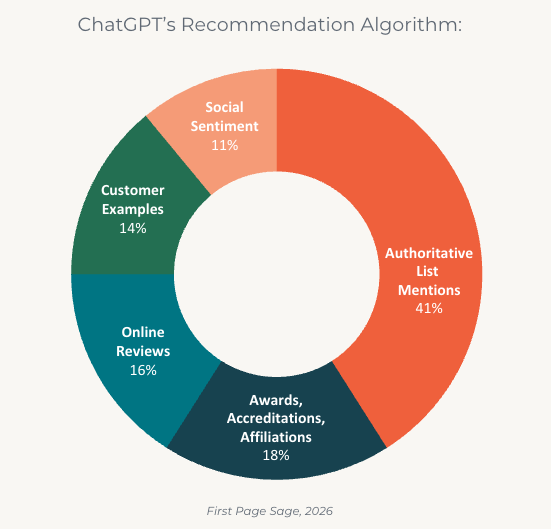
You get recommended when credible third parties name you as the best across the web. According to First Page Sage’s 2026 analysis of ChatGPT’s recommendation algorithm, authoritative list mentions account for 41% of the recommendation signal, with awards and accreditations at 18% and online reviews at 16%.
That’s why PR is your highest-leverage GEO move. A shortlist appearance in TTG’s Top 50 Travel Agencies, a mention in Condé Nast Traveller’s best tour operators, or coverage in a niche destination blog – every credible source teaches LLMs to recommend you.
Earned-content priorities for travel companies:
- Reviews – automate a post-trip email or push notification via your app asking happy clients for Google, Trustpilot and TripAdvisor reviews. Testimonials on your own site don’t carry the same weight as third-party platforms.
- Listicles and PR – pitch one strong story angle per quarter to publications your ideal clients read. Use a freelance publicist if PR isn’t in-house.
- Awards – enter every relevant industry award; even shortlist mentions count.
- YouTube – LLMs are increasingly pulling from video transcripts. Even a 5-minute destination insight builds authority.
Your travel GEO action plan: 3 things to do before Monday
You don’t need to overhaul your whole site to start. In our study, 50% of travel companies said they were ready to start GEO in the near future – so this is your moment. Do these three things this week and you’ll be ahead of the 90% who haven’t begun.
- Audit yourself – ask ChatGPT, Claude and Gemini the questions your customers actually ask (“best operator for a Botswana honeymoon”, “is [your brand] reliable?”). Record where you appear and where you don’t.
- Rewrite one existing blog post in GEO style – question-led heading, answer in the first sentence, FAQs, specific figures, extractable stats.
- Earn one third-party mention – pitch one publication, or ask your top 10 repeat clients for a Google or Trustpilot review this week.
Where Vamoos fits into your GEO travel strategy
Travel GEO only works if the trip lives up to the AI recommendation. If a traveller is sent your way and the experience falls flat, no reviews follow – and the AI flywheel stalls.
Vamoos is the app for travel companies, giving clients everything they need for their trip in one beautifully branded place. From the moment they book, your logo and a live countdown build anticipation. On the trip, they have offline itineraries, maps, flight alerts and 24/7 messaging in their pocket. Once they’re home, post-trip e-brochures and push notifications prompt the reviews, social posts and repeat bookings that feed your GEO strategy directly.

Vamoos clients including Black Tomato, Scott Dunn and Savile Row see a 12% lift in repeat bookings – because happy clients are the foundation of earned content, and earned content is the foundation of AI recommendation.
Ready to turn satisfied travellers into your strongest AI search signal? Book a Vamoos demo and see how the best in travel turn the post-booking experience into a marketing loop that builds itself.
Read more:
FAQs
How long does it take to see results from a travel GEO strategy?
Travel GEO results typically take longer to show than traditional SEO, since AI engines need repeated citations and third-party mentions before they start recommending a brand consistently. Most operators see early movement within a few months of rewriting content in question-led format, but earning enough reviews, PR mentions and listicle appearances to shift AI recommendations tends to take longer and compounds over time.
Do travel companies need to choose between SEO and GEO?
No, travel companies don’t need to choose between SEO and GEO, since the two overlap heavily and reinforce each other. SEO makes up roughly 90% of the groundwork AI search relies on, so a solid SEO foundation is what makes GEO possible, not a separate strategy to run instead of it.
How can travel companies track whether AI tools are mentioning them?
Travel companies can track AI mentions by manually asking ChatGPT, Claude and Gemini the questions their customers would ask and recording whether they appear in the answer. Tools like SEMrush, Ahrefs and Google Search Console are increasingly building AI-visibility tracking into their reporting too, making it easier to monitor mentions over time rather than checking manually.
Can small or niche tour operators compete with big brands in AI search?
Yes, small and niche tour operators can compete with larger brands in AI search, often more easily than in traditional Google rankings. AI engines reward depth of expertise on a specific question, so an operator with genuine authority on a narrow destination or trip type can get cited ahead of a generic, broader competitor.
Does GEO replace the need for travel PR and reviews?
No, GEO doesn’t replace PR and reviews, it depends on them. Authoritative list mentions account for a large share of what makes AI engines recommend a business, according to First Page Sage’s 2026 analysis, which puts list mentions at 41% of the recommendation signal, awards and accreditations at 18% and online reviews at 16% – making earned coverage the backbone of GEO rather than a nice-to-have alongside it.