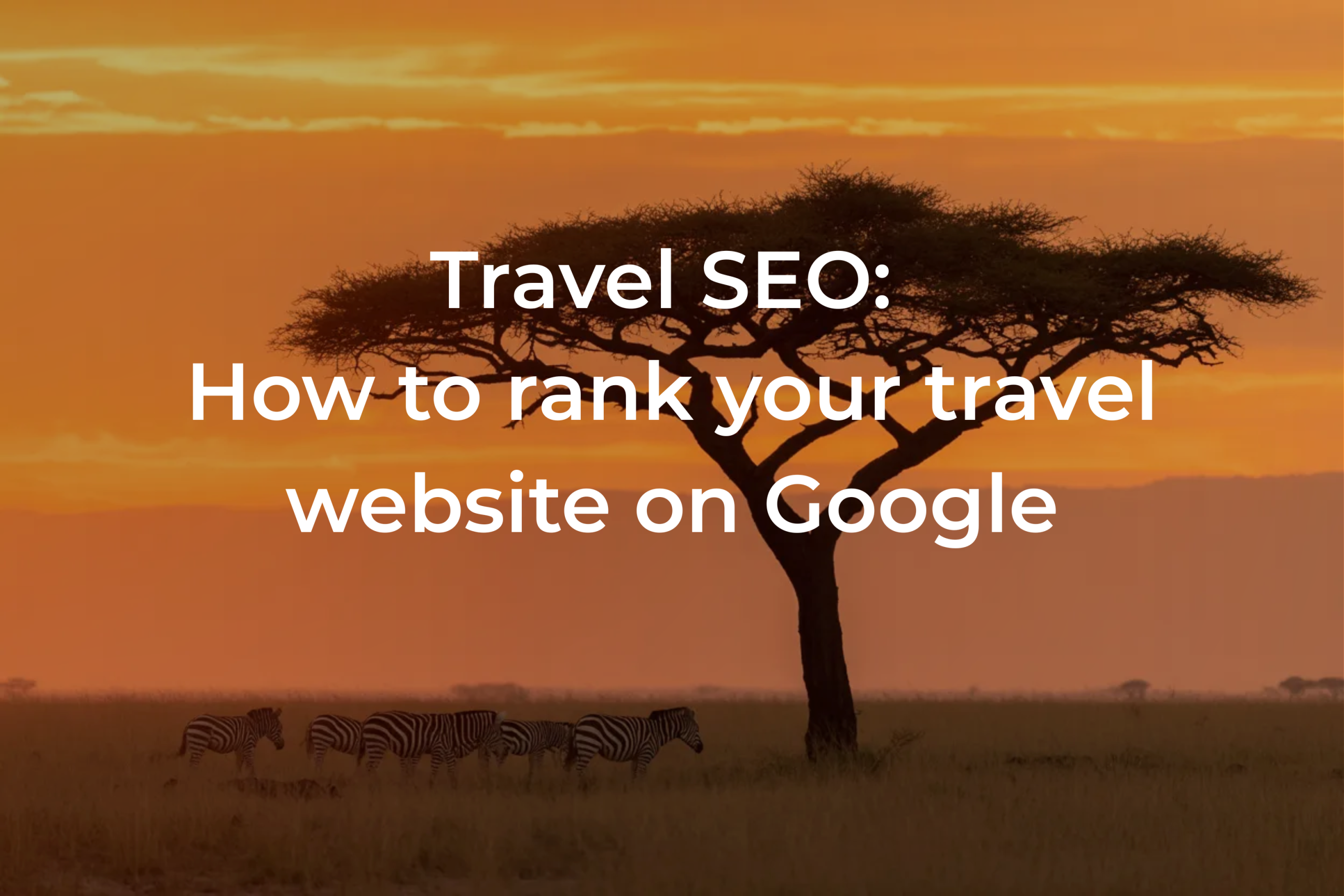
Travel SEO is the practice of optimising your website so it ranks highly on Google when travellers search for trips, destinations and operators like you. Done well, it turns search into your most reliable booking channel – one that works around the clock without paying per click. For tour operators competing against OTAs with huge budgets, strong travel SEO is often the single highest-return marketing investment available.
It also matters more than ever because of AI. With ChatGPT, Gemini and Google AI Overviews now answering travellers’ questions directly, many operators assume search optimisation is being replaced – but Google confirmed in May 2026 that optimising for AI search is still SEO, built on the same foundations. Get the fundamentals right and you’re already most of the way to AI visibility too (more on that, and the changing AI landscape, in our recent webinar with Google).
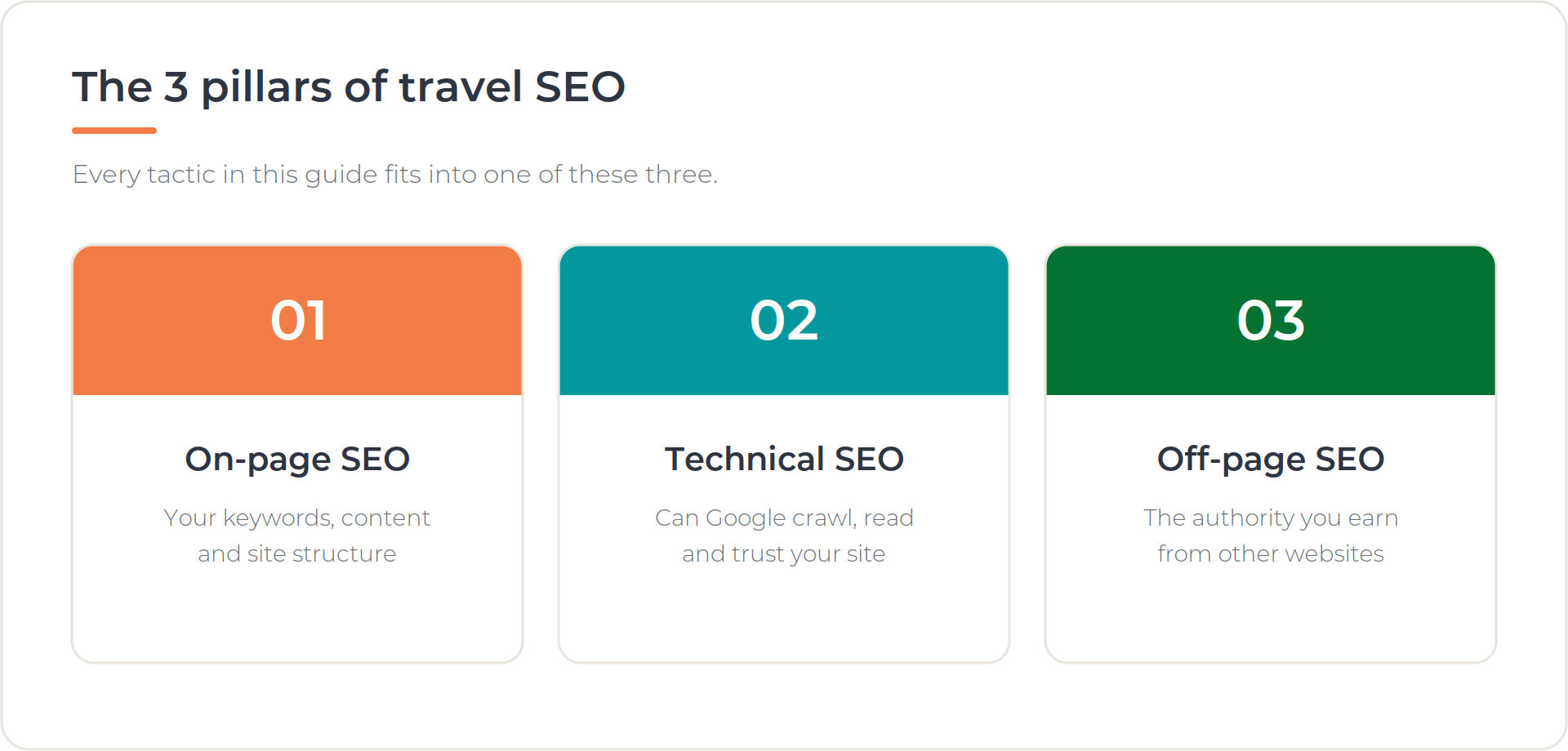
SEO for travel is built on three pillars:
- On-page SEO (your keywords, content and structure)
- Technical SEO (can search engines crawl and read your site)
- Off-page SEO (the authority you earn from other sites linking to you)
This guide makes all three concrete for travel – plus how AI search fits into the same framework.
Why search beats paid ads for travel companies
Organic search delivers compounding returns, while paid search stops the moment you stop paying. A page that ranks well keeps bringing in bookings for years on the back of one piece of work, whereas a Google Ads campaign resets to zero the day the budget runs out. For seasonal travel businesses, that durability matters enormously.
It also builds trust that ads can’t buy. Travellers researching a £10,000 trip click an operator that ranks organically for “luxury Kenya safari specialists” far more readily than one that only appears as a sponsored result. Organic visibility earns you a place in the consideration set, not just a click.
What travel SEO keywords should you target?
On-page SEO starts with identifying the keywords your potential customers are using. The best travel SEO keywords are specific, intent-led phrases that match how your ideal client actually searches – not broad head terms you’ll never outrank the OTAs for. A small operator will not beat Expedia for “holidays”, but it can absolutely own “tailor-made Namibia self-drive safari” or “small-group walking holidays in the Dolomites”.
To find them, use a keyword research tool. SEMrush and Ahrefs are the industry standards – they show search volume, how hard a term is to rank for, and which keywords competitors are already winning. Google Keyword Planner and Google Search Console are solid free alternatives. You’re hunting for the sweet spot: enough monthly searches to matter, low enough difficulty to be realistic, and clear booking intent.
Group what you find into three buckets:
- Destination keywords – “luxury Sri Lanka holidays”, “family villas in Puglia”. High intent, high competition. Win these with genuinely expert, in-depth pages.
- Experience keywords – “guided gorilla trekking tours”, “ski-in ski-out chalet holidays”. These match travellers who know the trip type but not the destination.
- Long-tail question keywords – “is November a good time to visit Patagonia”, “how much does a private Galápagos cruise cost”. Lower volume, lower competition, very high conversion.
The mistake most travel companies make is chasing volume. A keyword with 200 searches a month and clear booking intent beats one with 20,000 searches and none.
Where should travel SEO keywords go, and how often?
Each page should target one primary keyword placed in the positions search engines weigh most heavily: the meta title, the meta description, the H1 heading, the URL, the first paragraph, and at least one subheading. Land it in those spots and you’ve covered the high-value real estate.
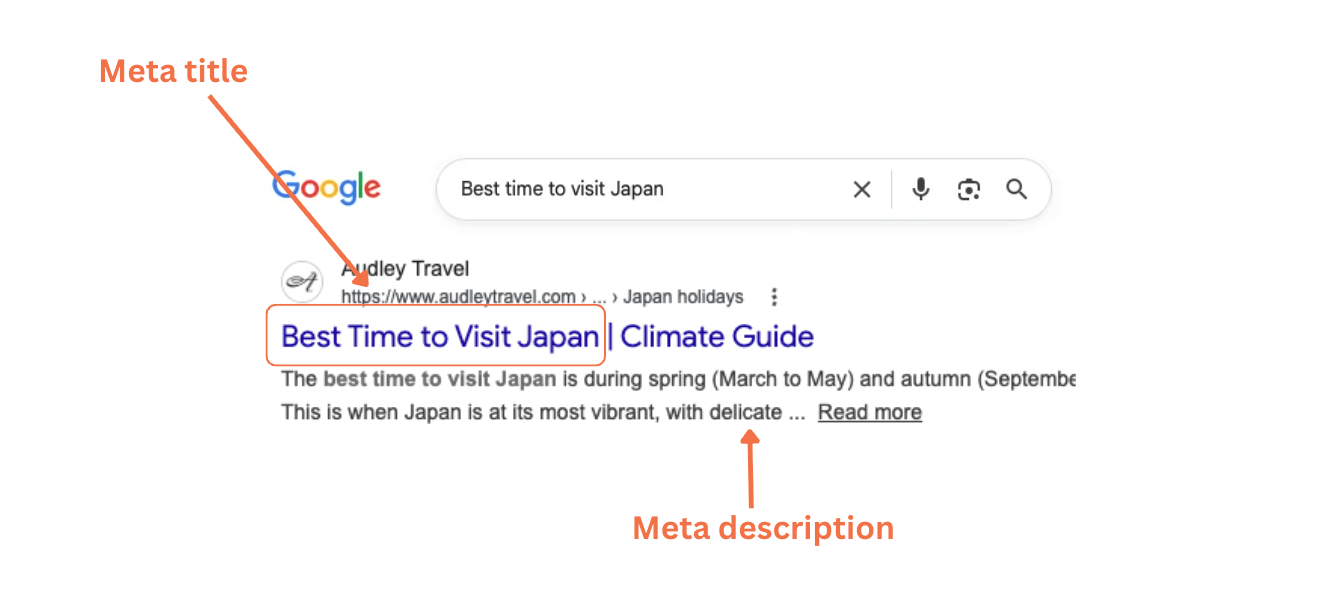
In the body, write naturally and don’t count obsessively. There is no magic number, and Google does not reward keyword density – forcing a phrase in 20 times now does more harm than good. As a rough benchmark, three to six natural mentions across a 1,000-word page is typical, but treat that as a side effect of writing well rather than a quota. Support the exact phrase with variations and related terms, and if a sentence reads awkwardly, rewrite it – relevance and readability beat repetition every time.
Don’t overlook image alt text and internal links. Describing a photo as “luxury Serengeti safari camp” and linking to that page with relevant anchor text both quietly reinforce what the page is about.
The technical basics behind SEO for travel websites
The technical basics are speed, mobile usability, crawlability and structured metadata – the second pillar, and what lets Google find, read and trust your pages. Travellers research on phones, often on poor connections, so a slow or clumsy mobile site quietly costs you rankings and bookings.
The good news is you no longer need to be technical to find the problems. AI tools like Claude can now run a technical audit of your site and tell you in plain English what’s working and what isn’t – no SEO agency required. The essentials worth checking:
- Page speed – large destination images are the most common cause of slow travel sites
- Mobile-first design – most travel research happens on mobile, and Google ranks the mobile version of your site
- Title tags and meta descriptions – every page needs a unique one with its target keyword near the front
- Image alt text – describe your imagery properly; it helps accessibility, image search and overall relevance
- Indexing – make sure your key pages aren’t accidentally blocked, and submit a sitemap in Google Search Console
Some of this you can handle yourself. If your site runs on WordPress with an SEO plugin like Yoast, or a builder like Squarespace or Wix with SEO settings built in, meta titles, descriptions and alt text are all editable yourself.The heavier technical fixes, like site speed or indexing errors, are where you’d hand the list to your website developer. Strong SEO for travel website performance depends on getting these basics right – they’re the bedrock of travel website SEO, and spotting the problems is now the easy part.
How do you build off-page authority for a travel website?
Off-page SEO is everything that happens away from your own site to build its authority – mainly backlinks, the links from other websites pointing to yours. Google treats each quality link as a vote of confidence, so a travel site linked to by respected publications and partners ranks far more easily than one with none.
For travel companies, the links worth earning tend to come from:
- Travel media and listicles – a place in a “best tour operators for X” round-up passes real authority
- Partners and suppliers – DMOs, hotels, ground agents and tourism boards you already work with linking back to you
- Digital PR – coverage of a new trip, a survey or an expert comment, each typically carrying a link
- Niche blogs and guides – smaller relevant sites still count, so don’t only chase the big names
Quality beats quantity every time. One link from a trusted travel publication is worth more than fifty from low-quality directories – and buying links breaks Google’s guidelines and can get you penalised. These same earned mentions also help AI tools recommend you, which we cover in our GEO guide.
How to structure a travel website for SEO
The best travel website structure starts with clear topic clusters: one strong pillar page per major destination or trip type, supported by detailed articles that link back to it. This signals depth and authority to Google, which rewards sites that comprehensively cover a subject over those that mention it once.
A practical structure for SEO for travel websites:
- Pillar pages – your core money pages (e.g. “Tanzania Safari Holidays”), targeting the main destination keyword
- Supporting content – guides answering specific questions (“Best Time to Visit the Serengeti”, “Tanzania Safari Packing List”) that link up to the pillar
- Internal linking – every supporting article links to its pillar and to related guides, passing authority and keeping travellers on your site
- Clean URLs – short, keyword-led and readable, like /tanzania-safari-holidays, not /page?id=2841
This cluster model is the backbone of travel website SEO. It tells search engines you’re a genuine authority on a destination, not a thin listings page.
How does AI search change travel SEO strategy?
AI search doesn’t replace travel SEO – it runs on the same foundations. In May 2026, Google published official guidance stating plainly that “from Google Search’s perspective, optimising for generative AI search is optimising for the search experience, and thus still SEO.” Google confirmed its AI features are rooted in the same core ranking and quality systems as regular Search, which means if you already rank well, you’ll tend to show up in AI search too.
That said, AI search does reward a few habits more heavily – leading with direct answers, strong FAQ sections, and content that shows genuine first-hand expertise rather than commodity information. We covered the travel-specific playbook for this in detail in our recent webinar with Google, and in a dedicated guide on GEO for travel companies. If AI visibility is on your radar, start there – but the reassuring takeaway is that the work is the same work. A well-optimised site is already most of the way there.
How long until search starts driving bookings?
SEO typically takes three to six months to show meaningful movement, and longer for competitive destination keywords. It’s a compounding investment, not an instant switch – early work on structure and content keeps paying off well after it’s done. The operators who win are the ones who start before their competitors and stay consistent.
Track progress so you know it’s working. The same tools you used for research – SEMrush and Ahrefs – monitor where you rank for each target keyword over time, while Google Search Console shows the real queries bringing people to your site for free. Check monthly, not daily; SEO moves slowly and obsessive checking just creates noise.
Set the expectation internally that the first quarter is groundwork. Rankings, traffic and bookings tend to build slowly, then accelerate once Google trusts your site as an authority on your destinations.
Putting your travel SEO strategy into action
Strong travel SEO comes down to three things: target specific, intent-led keywords; structure your site into authoritative destination clusters; and keep the technical foundations clean. Do those consistently and search becomes a booking channel that compounds year on year.
Vamoos is the app for travel companies, giving clients everything they need for their trip in one beautifully branded place. The connection to search is direct: happy travellers leave the reviews, referrals and repeat bookings that strengthen your authority over time. With offline itineraries, live flight updates, maps and 24/7 messaging in one branded app, operators like Black Tomato, Scott Dunn and Savile Row turn every trip into the kind of experience clients talk about – and that word of mouth feeds straight back into your rankings.
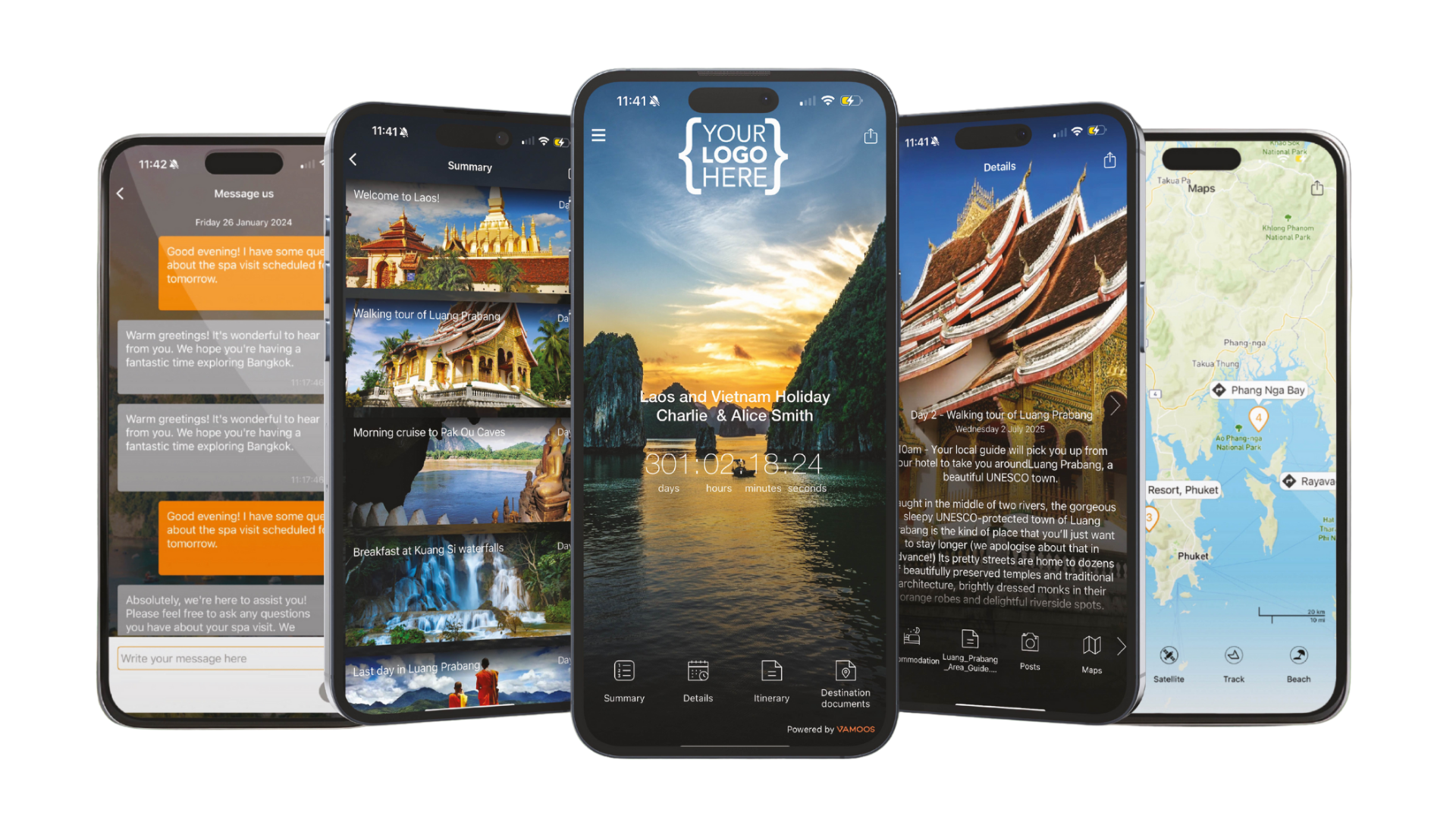
Want to see how a better post-booking experience supports your wider growth? Arrange a Vamoos demo, and we’ll show you what’s possible for your brand.
Read more: