You’ve decided your travel company needs an app. Good call. The question is how you get one – and the answer affects your budget, your timeline, and your sanity for years to come.
Travel app development cost is the total investment required to design, build, launch, and maintain a mobile application for a travel company. That last word – maintain – is the one most operators forget to factor in. And it’s where the numbers get uncomfortable.
There are now three routes on the table:
- Hire a travel app development company to build something bespoke
- Use AI coding tools to build it yourself
- Buy a ready-made SaaS platform
Each looks very different at the start. Over three years, the picture changes dramatically.
How much does travel app development cost to build from scratch?
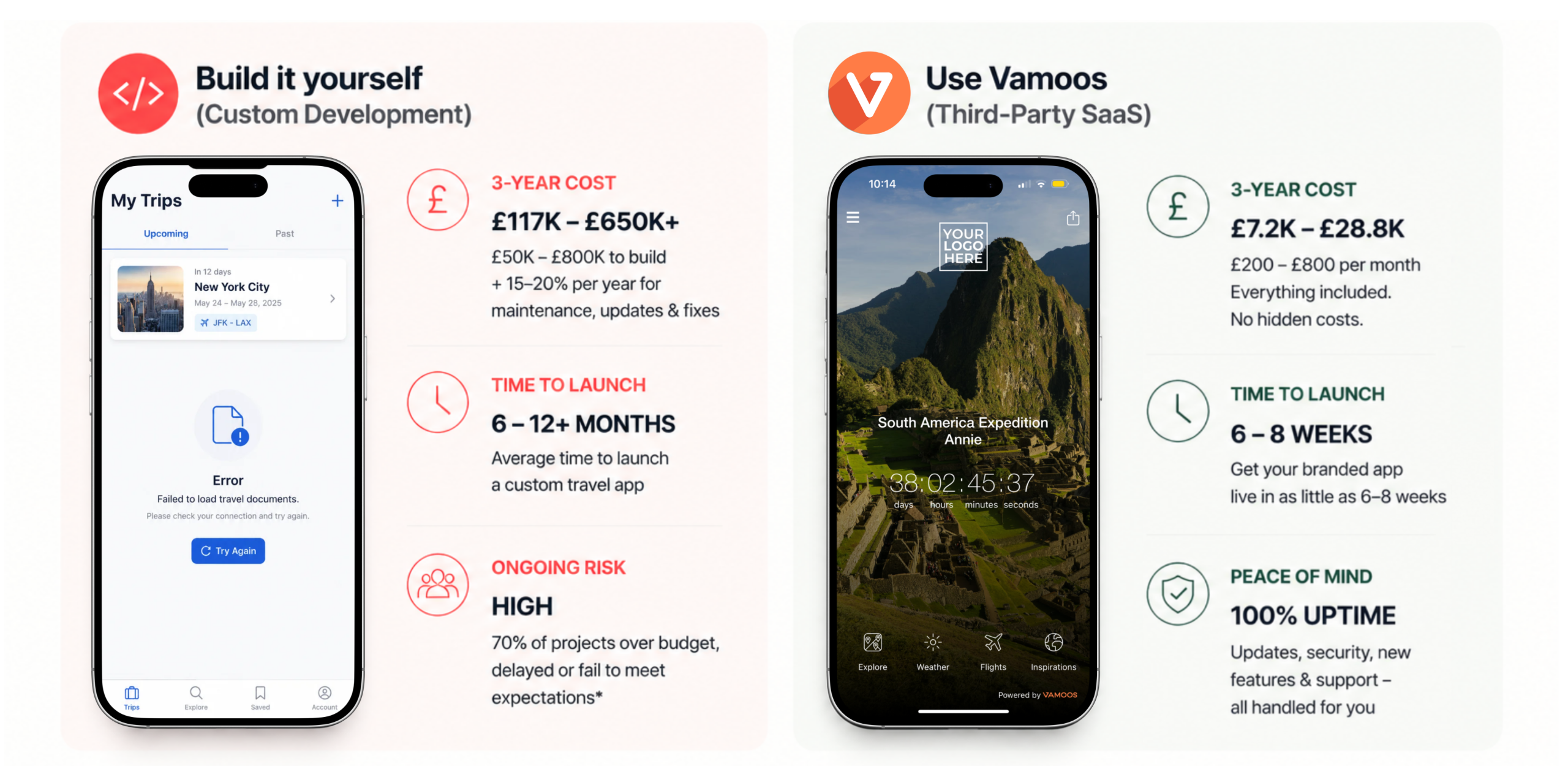
Building a custom travel app from scratch typically costs between £50,000 and £300,000, depending on complexity, with most mid-range projects landing between £100,000 and £300,000. Quotes from a travel app development company will usually cover the initial build only – design, development, testing, and launch.
The ongoing costs are where operators get caught out. App maintenance, bug fixes, OS updates (Apple and Google release major updates annually, and your app must keep pace), security patches, and new feature development typically add 15-20% of the original build cost every year. A £150,000 app costs £22,500-£30,000 per year just to stand still.
Then there’s the team. A functioning travel app needs front-end and back-end developers, a UX designer, a QA tester, and a project manager. According to the Standish Group CHAOS Report 2020, only 30% of software development projects are delivered on time, on budget, and to the agreed scope. The other 70% are either cancelled or fail to meet expectations – and the ones that do complete almost always cost more than planned.
There is also a longer-term consideration. Technology in the travel sector is moving faster than at any point in the industry’s history – AI tools, new booking integrations, evolving passenger expectations, and changes to how travellers consume information on their devices. Every time a meaningful advancement arrives, a custom-built app has to be redeveloped to keep pace. That cost and that decision lands entirely with you. A third-party platform like Vamoos has a dedicated product team whose entire job is staying ahead of those changes — new features, new integrations, and new capabilities land automatically as part of your subscription, without a redevelopment project or an additional invoice.
Can I use AI to build a travel app cheaply?
AI coding tools can generate a working travel app prototype in days, but the ongoing costs and risks make this a false economy for most tour operators. Tools like Cursor and Lovable have made it possible for a non-developer to produce something that looks like an app. The problem is what happens next.
Every app on the App Store or Google Play requires ongoing compliance with Apple and Android guidelines that change regularly. GDPR compliance, data security, and passenger data protection are legal obligations. When something breaks at 11pm before a client’s departure, there is no support desk to call.
AI-generated code can work without being well-structured. Without an experienced developer reviewing the output, small problems compound – and the tool that appeared to save £100,000 in development costs becomes a maintenance burden with no clear owner. For a tour operator, a bug that drops a client’s documents while they’re in the middle of the Amazon rainforest is not a technical inconvenience. It is a client relationship problem.
How much does a third-party travel app actually cost?
A third party travel app platform is a pre-built, subscription-based solution that replaces the entire development process with a monthly fee. With Vamoos, that typically costs between £200 and £800 per month depending on the size of your operation. There are no setup fees, no development sprints, no OS update bills, and no emergency developer callouts.
The subscription covers everything: hosting, security, bug fixes, new features, and support. When Apple releases a new iOS version, Vamoos updates. When GDPR requirements shift, Vamoos adapts. You are effectively paying for a dedicated technical team without employing one.
Vamoos maintains 100% uptime, and every operator gets a dedicated customer support representative who handles onboarding, training, and ongoing guidance. If something needs fixing or your team needs help getting more from the platform, there is always someone to call – something no custom-built app can offer.
Building your own app might seem like the only way to get exactly what you want – but with Vamoos, you’re not sacrificing customisation by choosing SaaS. Vamoos Studio lets operators build completely bespoke tools inside their app using simple web technology: safari spotting trackers, golf scoring tools, loyalty schemes, referral programmes, tip calculators, packing list builders. Bespoke in-app functionality – for a fraction of the travel app development cost to build the same features from scratch.
Vamoos also includes purpose-built AI tools that no custom-built app would come with out of the box:
- TripImport scans an existing PDF itinerary and converts it directly into the app in seconds, eliminating manual re-entry
- Imsert auto-tags an operator’s entire image library by location and content, then surfaces the right visuals as itineraries are built
These tools represent years of product development – and they come included with a subscription, not as an extra line on a development quote.
How long does travel app development take?
A custom-built travel app takes between six months and over a year to reach launch, with ongoing development continuing indefinitely. A third-party SaaS travel app can typically be set up and live within six to eight weeks.
For tour operators weighing up travel app development, the timeline question matters as much as the cost. Every month spent in development is a month clients are still receiving PDFs.
Which option is right for a tour operator?
For most tour operators, buying a third-party travel app platform delivers better ROI than going with a travel app development company. Custom development makes sense when an operator’s requirements are genuinely unique and cannot be met by any existing platform. For the vast majority – who need visual itineraries, offline documents, flight alerts, client messaging, and branded delivery – the SaaS route gets there faster, cheaper, and with far less risk.
Vamoos is an app for travel companies, giving your clients everything they need for their trip in one beautifully branded place. Trusted by 500+ travel companies across 50+ countries, operators using Vamoos save 10 hours of admin time per week and see a 40% reduction in itinerary building time – without a single line of travel app development code. You can calculate the ROI Vamoos would bring you here.

If you are weighing up travel app development cost against the SaaS alternative, why not have a look at exactly what Vamoos can do for your business. Book a personalised demo and we will walk you through it…
Read more:
- The top travel industry news sites for tour operators
- The AI tools saving tour operators hours every week
- The best tour operator software 2026
FAQs
Is it cheaper to build a travel app or buy a ready-made one?
Buying a ready-made travel app platform is cheaper than building one from scratch for the vast majority of tour operators, once maintenance costs are factored in. A custom build can cost £50,000 to £300,000 upfront plus 15-20% of that figure every year to maintain, while a subscription-based platform like Vamoos covers hosting, updates and support for a monthly fee with no separate maintenance bill.
Do I need a developer to run a third-party travel app?
No, a third-party travel app platform does not require you to employ a developer, since the provider handles hosting, security, bug fixes and OS updates as part of the subscription. Vamoos also assigns every operator a dedicated customer support representative for onboarding and training, so there is always someone to call if something needs fixing.
Can a third-party travel app still be customised for my business?
Yes, a third-party travel app can be fully customised without the cost of building bespoke software from scratch. Vamoos offers white-label options, so operators can add their own logo, colours and branding, meaning clients experience it as your app with no indication a third-party platform sits behind it. Vamoos Studio also lets operators build their own in-app tools using simple web technology, from safari spotting trackers to golf scoring tools and loyalty schemes, at a fraction of the travel app development cost of building the same features independently.
What should a tour operator look for in a travel app?
A tour operator should look for a travel app that covers visual itineraries, offline document access, flight alerts, client messaging and branded delivery as standard. These are the core features most operators need, and a SaaS platform typically delivers all of them faster and at lower risk than a custom development project built around the same requirements.
Is it risky to build a travel app using AI?
Yes, building a travel app using AI coding tools carries real risk for tour operators, even though a working prototype can be generated in days. AI-generated code can work without being well-structured, and without an experienced developer reviewing it, small problems compound into a maintenance burden with no clear owner, on top of ongoing GDPR and app store compliance obligations that don’t disappear just because a developer wasn’t involved.