A few years ago, a traveller planning a trip typed three words into a search box and trusted the first familiar link. That traveller is long gone. They’re on a quest now – asking long, personal, paragraph-shaped questions of ChatGPT, Gemini, Claude and Google’s AI Overviews – and if your travel company isn’t waiting where that quest leads, you won’t be found at all. The good news? Your competitors haven’t worked out where the trail goes either. Yet.
Why we got Google in the room
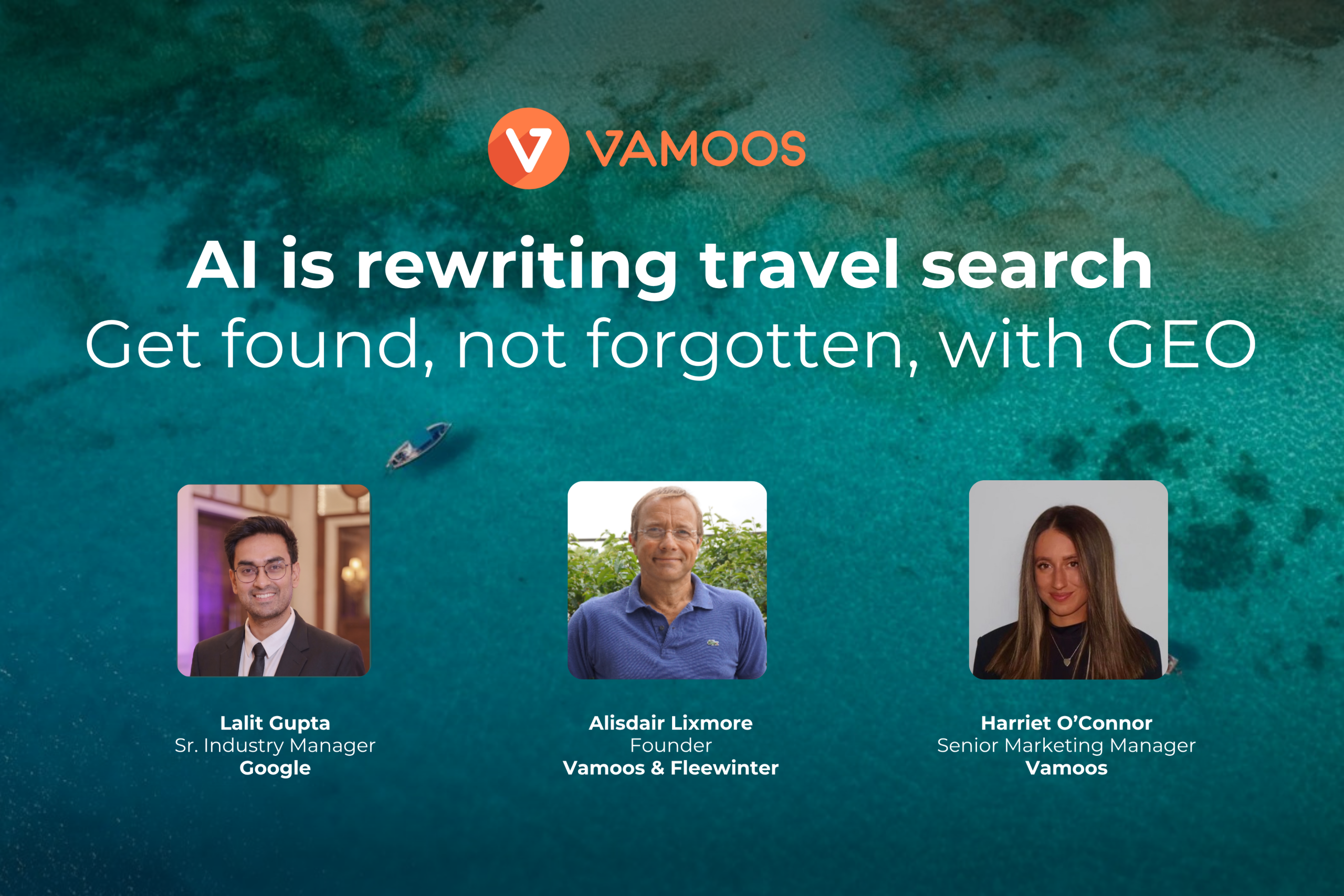
On 13th May 2026 we ran AI is Rewriting Travel Search: Get Found, Not Forgotten, with Google in the partner seat. Lalit Gupta, Senior Industry Manager at Google, brought over a decade of work with hospitality brands, and data the industry hasn’t seen yet. Harriet O’Connor, Senior Marketing Manager at Vamoos, turned the theory into a plan you can make a start on before Monday. And Alistair Luxmoore, founder of Vamoos and Fleewinter, steered the conversation – on the day, firmly in his tour operator’s shoes, asking the questions you requested.
Why now? Because the ground has genuinely moved. In a Vamoos poll, 32% of travel companies named losing organic traffic to AI-generated answers as a worry – yet only around 10% have an active GEO strategy. Awareness is high. Action is almost nonexistent. That gap is the window.
Questions are now quests
Lalit’s opening point was simple: search has changed more in one year than in the entire decade before it. Search once had a syntax – you typed “hotels in London” and did the sifting yourself. That same traveller now types “hotel for a family of four with an indoor pool, close to all the fun activities in central London” – typos left in, and full confidence that Google will understand anyway. In AI Mode, queries run two to three times longer than traditional search; questions over eight words now make up the bulk of volume and are still growing. Google handles five trillion of them a year.
“This has truly turned questions into quests,” Lalit said – and the surfaces have multiplied to match: AI Overviews, AI Mode, and Gemini now built into Google Maps. The instinct is to panic about lost clicks. Don’t. Click-back rates from AI surfaces are down year on year, but time on page and page depth are up. Fewer visits – better-qualified ones, from people who’ve already done their homework.
So how do you actually show up? Lalit’s answer was refreshingly un-technical: don’t rebuild your site for the machines. Write original, expert, opinionated content for humans – and treat your whole website as one enormous answer key.
“Think of your business as a big giant FAQ page.” – Lalit Gupta, Google
In practice, that means three things.
- Work backwards from the question, not the keyword – take that long, specific query and make sure a page answers it directly, in the first sentence, the way a knowledgeable friend would.
- Sell the experience, not the inventory – “a tour of the Serengeti” is a commodity line every rival can write; what it feels like, who it suits, what a first-timer notices versus someone on their fifth safari is the nuance AI can’t fake, and the reason it cites you over the operator down the road.
- Go genuinely multimodal – sharp images placed beside the text they illustrate, with descriptive alt text, and videos given their own space, because LLMs increasingly read transcripts and your images too. The old basics – titles, meta descriptions, internal links – still hold.
One free tip from Lalit worth acting on this week: open your Search Console and read the actual queries already bringing people in. Those long questions are a content brief, handed to you by the people you most want to reach.
Long enough to win, short enough to read
Here the panel pulled in opposite directions – Lalit wanted operators to go as deep as humanly possible, because LLMs can absorb near-limitless detail. Alistair pushed back as a practitioner: real clients can’t. Bury your headline under 4,000 words of itinerary, and you lose the human even as you win the algorithm.
They met in the middle. Keep the punchy, attention-grabbing summary at the top for the person – then let the depth live underneath for the machine. You don’t choose between them. You stack them.
Paid search gets an AI rebuild
When talk turned to advertising, Alistair brought some healthy scepticism.
“I built my first travel business on Google AdWords at 30p a click. Those days are long, long gone.” – Alistair Luxmoore, Vamoos / Fleewinter
And across ten years, almost every new Google Ads feature a rep talked him into has underdelivered. Lalit took the point – the old interface was the problem, but pointed to the newer numbers behind the newer AI-driven tools. AI Max is driving 27% more conversions at a similar cost-per-acquisition and ROAS (Return on Ad Spend) target. Demand Gen delivered a 26% year-on-year lift in return per pound spent. Performance Max still beats Meta’s Advantage+ for travel advertisers, and combining Google and YouTube media drives 21% higher ROAS than other media. Ads are moving into AI Overviews and AI Mode – live in the US, coming to other markets.
One exclusive reveal, previewed on the webinar ahead of Google Marketing Live, was AI Briefs: describe your business, your ideal customer and your key messages in plain English, and Google handles the keywords, creative and audience – with negative keywords, brand controls and URL inclusion or exclusion built in. For an operator who knows exactly who isn’t their customer, that’s the conversation with the ad platform they’ve always wanted.
Your GEO action plan
Harriet brought it back down to what you can actually do to get found. As she put it: “SEO is 90% of the work. GEO is the extra 10% on top.” Same discipline – you simply swap keywords for the full, conversational questions people ask LLMs, then answer them with question-led headings and the answer in the very first sentence.
She split the work into two jobs. Get cited – through content you own, so that when someone asks “the best time to visit Japan”, your page is the source the AI quotes. Get recommended – through earned content (what other people are saying), so that when someone asks who to book with, the AI names you.
“AI is the internet’s biggest gossip. If everyone online is saying you’re the best, LLMs will say it too.” – Harriet O’Connor, Vamoos
That gossip travels through reviews, Reddit threads, listicles, PR and awards – and the most powerful of all, Harriet noted, is being named on authoritative lists. So here are the three things she’d have you do before Monday:
- Audit yourself by asking ChatGPT, Claude and Gemini the questions your customers ask, and record what comes back
- Rewrite one existing blog post in GEO style
- Pitch one publication, or simply ask ten of your best repeat clients for a public review.
Do that, as Harriet put it, “and you are already ahead of 90% of travel companies.”
Want the full playbook? Read the complete GEO action plan here.
Where Vamoos comes in: GEO only works if the trip delivers
Here’s the catch: none of this matters if the trip falls flat. If AI sends a traveller your way and the experience disappoints, the glowing review never gets written – and the recommendation engine you’ve worked so hard to feed quietly stalls.
That’s the gap Vamoos is built to close. From the moment a client books, your branded app is on their phone with a live countdown that turns the wait into part of the trip. Through the journey, they’ve got offline itineraries, maps, live flight updates and direct messaging in their pocket. And afterwards, a timed notification asks – at exactly the right moment – for the review, and whether they’d like to travel with you again. That post-trip prompt is the quiet engine that produces the earned content LLMs pick up.

Your move. Don’t get forgotten on the quest
If there’s one thing to carry back to your desk, it’s this: every competitor has the same AI tools you do, so churning out generic content will never be the edge. Your expertise, your point of view, your firsthand knowledge – that’s the input that makes content worth citing and trips worth recommending. You don’t need a full rebuild. Start with one thing – one rewrite, one review, one pitch – and build from there. AI is the assistant. You’re still the author. Move now, while most of the industry is still standing at the trailhead.
Ready to close your own GEO loop? Book a Personalised Demo with the Vamoos team. See how a branded app, live countdown and timed post-trip notifications turn happy travellers into AI recommendations.